
| Donovan's Tiger Moth (formerly known as Aloa marginata) ARCTIINI, ARCTIINAE, EREBIDAE, NOCTUOIDEA | (donherbisonevans@yahoo.com) and Stella Crossley |
(Photo: courtesy of
Ian Common, from
Moths of Australia)
|
| Donovan's Tiger Moth (formerly known as Aloa marginata) ARCTIINI, ARCTIINAE, EREBIDAE, NOCTUOIDEA | (donherbisonevans@yahoo.com) and Stella Crossley |
(Photo: courtesy of
Ian Common, from
Moths of Australia)
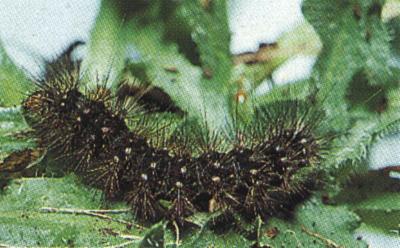
The Caterpillar of this species is dark brown with cream spots, and has lots of brown stiff hairs.

It has been found feeding on various herbaceous plants, from the families:

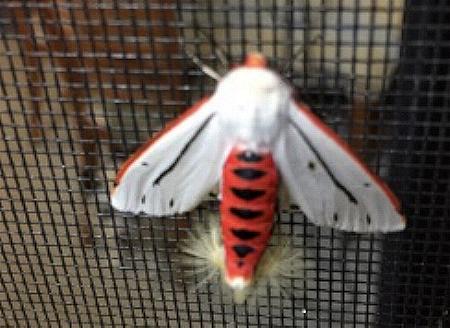
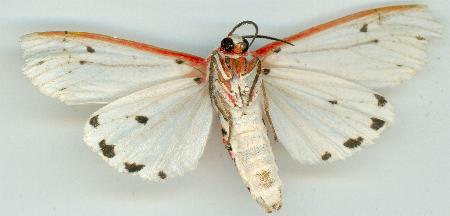
The head, thorax, and wings of the adult moth are usually basically white. The forewings each have a red and black line along the costa, and one or more black lines along the wing. The hindwings have a number of black spots, which may extend into each other in southern forms. The abdomen is usually red or yellow, with a black mark on top of each segment. The wingspan is 4 to 5 cms. The markings on the wings are quite variable. The red in the costal lines of the forewings can be orange or yellow.
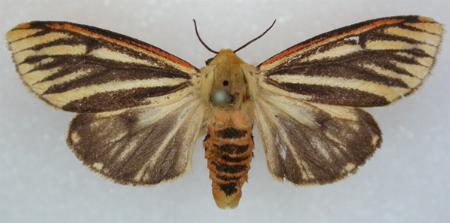
Southern forms often have extra straight black lines radiating from the base.
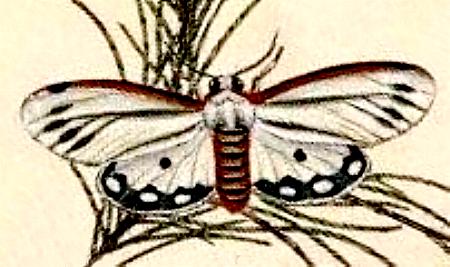
Northern forms tend to have reduced black markings.
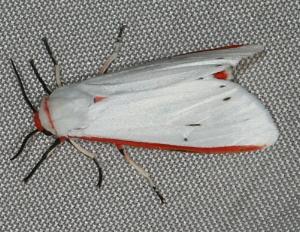
The female moths can evert a bunch of yellow hairs from the posterior, probably to disperse pheromones to 'call' a mate.
The species has been found over most of Australia, including:
A form of this moth described as Amsacta eurymochla Turner, 1926, which may be a synonym, has been found also in
Further reading :
David Carter,
Butterflies and Moths,
Collins Eyewitness Handbooks, Sydney 1992, p. 273.
Ian F.B. Common,
Moths of Australia,
Melbourne University Press, 1990, p. 436.
Edward Donovan,
General Illustration of Entomology,
An Epitome of the Natural History of the Insects of New Holland, New Zealand,
New Guinea, Otaheite and other Islands in the Indian, Southern and Pacific Oceans,
London (1803), p. 156. and also
Plate p. 154.
Peter Hendry,
The Australian Arctiid Moths (Lepidoptera: Noctuoidea: Erebidae)
with emphasis on Creatonotos Gangis,
Butterflies and Other Invertebrates Club,
Metamorphosis Australia,
Issue 65 (June 2012), pp. 12-13.
Peter Marriott,
Moths of Victoria - Part 2,
Tiger Moths and Allies - NOCTUOIDEA (A),
Entomological Society of Victoria, 2009, pp. 28-29,.
 caterpillar |  butterflies |  caterpillars |  moths |  caterpillar |
(updated 26 April 2013, 16 September 2026)