Synemon collecta Swinhoe, 1892
Striated Sun Moth
CASTNIIDAE,   SESIOIDEA
 
Don Herbison-Evans
(donherbisonevans@yahoo.com)
and
Stella Crossley

Synemon collecta
(Photo: courtesy of Trevor Jinks, North Burnett, Queensland)

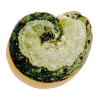
These Caterpillars spend most of their time underground, feeding on the roots of grasses (POACEAE) including

  • Wallaby Grass ( Austrodanthonia laevis ).

    Synemon collecta
    (Photo: courtesy of Trevor Jinks, North Burnett, Queensland)

    The adults have brown forewings with pale streaks, some containing elongated dark spots. The hindwings are bright yellow with an arc of dark brown spots. The wingspan is about 4 cms.

    Synemon collecta
    mating pair: female on the right
    (Photo: courtesy of Dave Britton, Armidale, New South Wales)

    The species has been observed in:

  • Queensland,
  • New South Wales,
  • Australian Capital Territory, and
  • Victoria.

    Synemon collecta
    female, listed as Synemon collecta
    ,
    drawing by F.C. Moore, lithograph by Mintern Bros. for Swinhoe,
    Catalogue of eastern and Australian Lepidoptera Heterocera in the collection of the Oxford University Museum,
    Part 1: Sphinges and Bombyces (1892), Plate VII, Fig. 16,
    image courtesy of Biodiversity Heritage Library, digitized by Smithsonian Libraries.


    listed as Synemon collecta

    drawing by Strand, lithograph by Hochdanz Co., printed by Werner & Winter, for Seitz
    in The Macrolepidoptera of the World, Alfred Kernen Verlag, Volume 10 (1933), Plate 1, fig c4,
    image courtesy of Biodiversity Heritage Library, digitized by Natural History Museum Library, London.


    Further reading :

    Charles Swinhoe,
    Sphinges and Bombyces,
    Catalogue of eastern and Australian Lepidoptera Heterocera in the collection of the Oxford University Museum,
    Clarendon Press, Part 1 (1892), pp. 151-152, No. 706, and also Plate 7, Fig. 16.


    previous
    back
    caterpillar
    Australian
    Australian Butterflies
    butterflies
    Australian
    home
    Lepidoptera
    Australian
    Australian Moths
    moths
    next
    next
    caterpillar

    (updated 6 November 2010, 1 October 2026)