
| Bright-orange Darter (previously known as Papilio augias) HESPERIINAE, HESPERIIDAE, HESPERIOIDEA | (donherbisonevans@yahoo.com) and Stella Crossley |

(Photo: courtesy of
Braden McDonald , Iron Range, Queensland)
|
| Bright-orange Darter (previously known as Papilio augias) HESPERIINAE, HESPERIIDAE, HESPERIOIDEA | (donherbisonevans@yahoo.com) and Stella Crossley |
(Photo: courtesy of
Braden McDonald , Iron Range, Queensland)
This Caterpillar is green, and has a pale brown head with an inverted dark 'V' mark. There is a faint dark line along the back. The Caterpillar grows to a length of about 3cms. It has been found feeding on :
The Caterpillar constructs a shelter out of leaves joined with silk, resting head downward in this by day, emerging to feed at night. The shelter is often constructed near the tip of the leaf on which it feeds, leaving only the midrib to support the shelter.

The butterflies of this species are brown with orange markings. The undersides are paler. The males have a long grey patch of the top of each forewing. The butterflies have a wingspan of about 3 cms.

Several subspecies of this species have been recognised across south-east Asia, including:
More subspecies have been proposed in Australia, including krefftii (Macleay, 1866), in

Further reading :
Michael F. Braby,
Butterflies of Australia,
CSIRO Publishing, Melbourne 2000, vol. 1, pp. 226-227.
Carl Linnaeus,
Centuria Insectorum,
Amoenitates Academicae,
Volume 6 (1763), p. 410, No. 80.
 caterpillar |  butterflies | 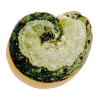 Lepidoptera |  moths |  caterpillar |
(updated 25 October 2009, 2 January 2026)