
| PERGIDAE, SYMPHYTA, HYMENOPTERA | (donherbisonevans@yahoo.com ) and Stella Crossley |

(Photo: courtesy of Ian Bevege,
Lilli Pilli, New South Wales)
|
| PERGIDAE, SYMPHYTA, HYMENOPTERA | (donherbisonevans@yahoo.com ) and Stella Crossley |
(Photo: courtesy of Ian Bevege,
Lilli Pilli, New South Wales)
These are not true Caterpillars, but are the larvae of a wasp, or more accurately a Symphytan. The larvae are gregarious, and they are often found in a knotted ball of many individuals. The larvae usually feed on

The larvae grow to a length of about 4 cms. They pupate in a communal cocoon on the trunk of an adjacent tree.
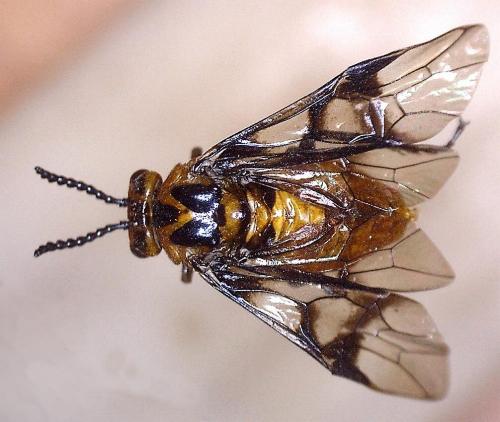
The adult insect (it is misnamed as a 'fly') is big and brown, with a black head and black markings on the thorax. the wings are transparent with some ver thick lack veins. The female has knobbly antennae.

The male has big feathery antennae. The females have a wingspan of about 2 cms, and the males about 1.5 cms. Curiously, the progeny of any one female are 90% females.
The larvae and adults of this family are quite harmless to people. They do not sting, as their cousins the communal wasps do.
This species has been found in
Various other species of Sawflies are ubiquitous, being found in :
Further reading :
Robert Bernard Benson,
A revision of the genus Pterygophorus Klug, sensu lato, with the description of two new genera (Hymenoptera, Symphyta),
Annals and Magazine of Natural History,
Vol. 1 (1938) p. 623..
 not-lepidoptera |  not-caterpillars |  Lepidoptera |  not-moths |  not-lepidoptera |
(written 21 April 2024, updated 18 June 2025)