
| (one synonym: Epicoma alba Turner 1922) NOTODONTINAE, NOTODONTIDAE, NOCTUOIDEA | (donherbisonevans@yahoo.com) and Stella Crossley |
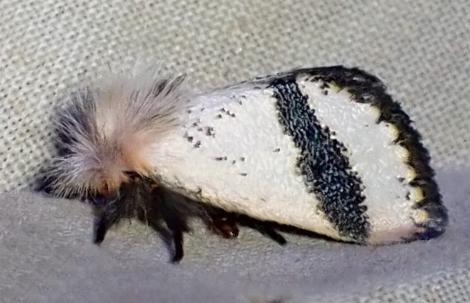
(Photo: courtesy of
Simon Ong,
Douglas-Daly, Northern Territory)
|
| (one synonym: Epicoma alba Turner 1922) NOTODONTINAE, NOTODONTIDAE, NOCTUOIDEA | (donherbisonevans@yahoo.com) and Stella Crossley |
(Photo: courtesy of
Simon Ong,
Douglas-Daly, Northern Territory)
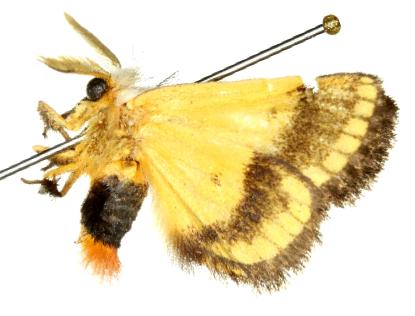
The adult moths of this species have varied forewings. One form has white forewings, each with a dark transverse line, and an arc of seven or eight dark-ringed pale yellow spots along the margin.
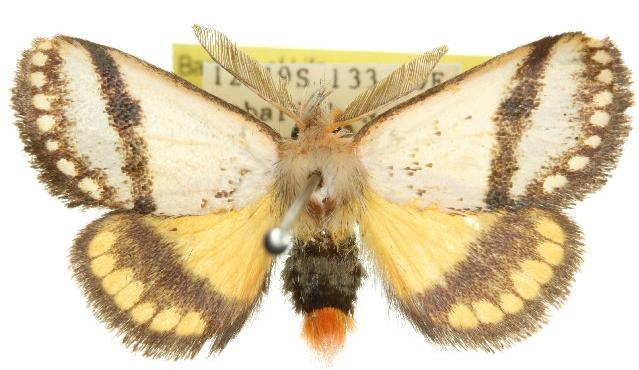
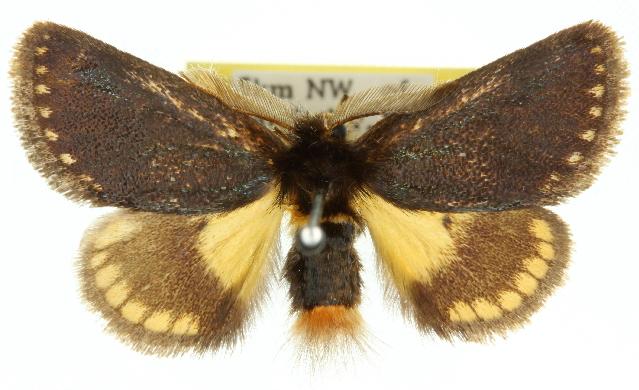
In other individual specimens: the forewings can have variable dark brown markings, some individuals being totally dark brown, but still with the arc of pale spots around the margin. The hindwings are pale yellow with a similar arc of marginal spots, and also a dark submarginal band of variable width, and sometimes a dark spot in the middle.
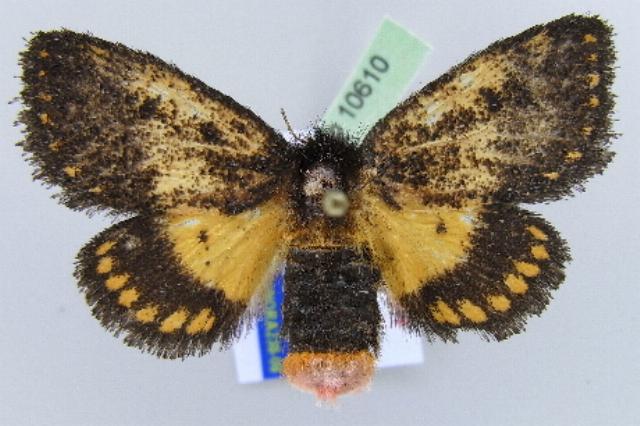
The thorax is covered by thick tuft of hairy scales, that are white in the white winged specimens, and dark brown in the darker winged specimens. The abdomen is covered in dark hairy scales, and there is a pale orange tuft on the tip of the abdomen. The wingspan of the males is about 3 cms. The wingspan of the females is about 4 cms.
The species has been found in
Further reading :
A. Jefferis Turner,
Revision of Australian Lepidoptera. Saturniadae, Bombycidae, Eupterotidae, Notodontidae,
Proceedings of the Linnean Society of New South Wales,
Volume 47 (1922), p. 369, No. 51.
 caterpillar |  butterflies |  Lepidoptera |  moths |  caterpillar |
(written 5 February 2026, updated 9 February 2026)