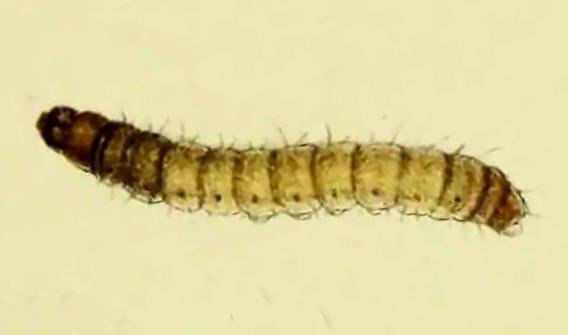
illustration by Buckler, Wendel, and Trap,
The larvæ of the British butterflies and moths,
Ray Society, London (1910), Plate CXLIX, fig.2,
image courtesy of Biodiversity Heritage Library,
digitized by Ernst Mayr Library, Harvard University.
The caterpillars of this moth are a
cosmopolitan pest on stored grain.
The caterpillars have a brown head and thorax, and an off-white abdomen
with sparse hairs, that has some darkened on segments near the
thorax.
The caterpillars each live in a shelter in the form of a tube of silk
covered in detritus, running along a crack, cranny or edge.
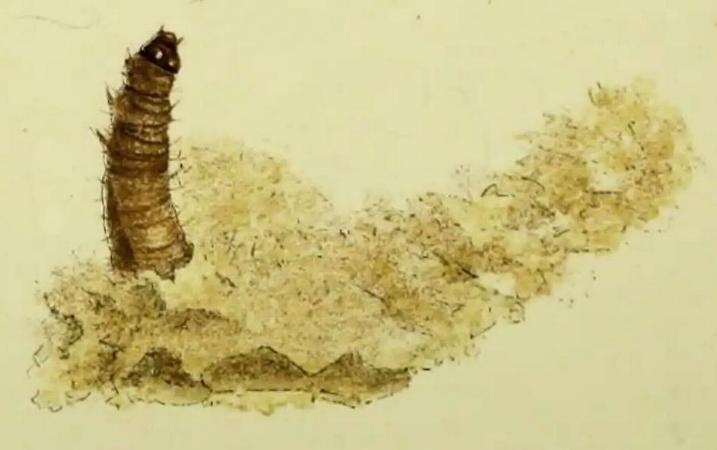
caterpillar with its tubular shelter
illustration by Buckler, Wendel, and Trap,
as above
The caterpillars feed on any vegetable matter, rotting or dry, including
hay,
grain of any kind, and
flour.
Although western society treats them as a pest,
in parts of China the caterpillars are cultivated,
and the frass
roasted to use as a flavouring for tea.
The caterpillars grow to a length of about 2 cms.
They each pupate in a tough white silk cocoon covered in detritus.
The pupa is brown and tubby with a a length of about 10 mm.,
and a width at the middle of about 3 mm.
The abdominal end has a set of six tiny curly hooks.

(Photo: courtesy of Amy Prendergast, Perth, Western Australia)
The adult moths have brown wings with arcs of white lines.
On the forewings, these separate darker patches at the
tip and base.
The eyes have a green sheen.
The moth typically rests with the tip of its abdomen turned up.
The wingspan is about 2 cms.

(Photo: courtesy of Laura Levens,
Upper Beaconsfield, Victoria)
The
Pheromones for this species have been determined.
The species has been found all over the world, including:
Canada,
Finland,
Great Britain,
Japan,
and most of Australia including
Queensland,
New South Wales,
Australian Capital Territory,
Victoria,
Tasmania, and
South Australia, and
Western Australia.

(Specimen: courtesy of the
The Australian Museum)
Further reading :
William Buckler,
The larvæ of the British butterflies and moths,
Ray Society, London (1910), Vol.9 (1901), pp. 21-23, and
Plate 149, fig. 2.
Ian F.B. Common,
Moths of Australia,
Melbourne University Press, 1990, fig. 31.19, pp. 68, 349.
Carl Linnaeus,
Insecta Lepidoptera,
Systema Naturae,
Edition 10, Volume 1 (1760), Class 5, Part 3, p. 533, No. 226.
Peter B. McQuillan, Jan A. Forrest, David Keane, & Roger Grund,
Caterpillars, moths, and their plants of Southern Australia,
Butterfly Conservation South Australia Inc., Adelaide (2019), p. 78.
Paul Zborowski and Ted Edwards,
A Guide to Australian Moths,
CSIRO Publishing, 2007, p. 53.
(updated 8 January 2013, 26 July 2026)