
| Currant Borer (one synonym : Sphinx ophioniformis Hübner, [1813]) SESIINAE, SESIIDAE, SESIOIDEA | (donherbisonevans@yahoo.com) and Stella Crossley |

(Photo: courtesy of Gyorgy Csoka,
Forest Research Institute,
Hungary)
|
| Currant Borer (one synonym : Sphinx ophioniformis Hübner, [1813]) SESIINAE, SESIIDAE, SESIOIDEA | (donherbisonevans@yahoo.com) and Stella Crossley |
(Photo: courtesy of Gyorgy Csoka,
Forest Research Institute,
Hungary)
This Caterpillar originated in Europe, and was unfortunately introduced into Australia by accident. It is a cosmopolitan pest, attacking of members of the plant family SAXIFRAGACEAE, particularly :
It bores into the stems to feed, and in so doing damages the plant. The caterpillar is a dirty white colour with a brown head. It grows to a length of about 2 cms.

The adult moth has a wingspan of about 2 cms. It has clear wings, and a black body with narrow yellow intersegmental bands on the abdomen. The pheromones of this species have been identified.
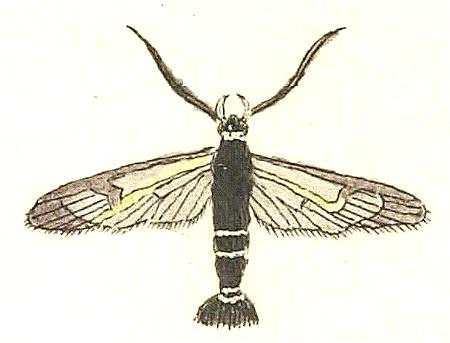
The species is now found in
as well as Australia, including:
Control of this pest is possible using :
Further reading :
Carl Alexander Clerck,
Icones Insectorum Rariorum : cum nominibus eorum trivialibus, locisque,
Volume 1, 1759.
Ian F.B. Common,
Moths of Australia,
Melbourne University Press, 1990, pl. 7.7, pp. 68, 288, 290.
R.J. Hardy,
The biology and behaviour of currant borer moth,
Synanthedon tipuliformis (Clerck) (Lepidoptera: Aegeriidae) in Tasmania,
Journal of the Australian Entomological Society,
Volume 21, Part2 (1982), pp. 103–109.
 caterpillar |  butterflies | 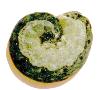 Lepidoptera |  moths |  caterpillar |
(updated 1 March 2009, 25 October 2026)