
| Imprimerie de Chardon | (donherbisonevans@yahoo.com) and Stella Crossley |
|
| Imprimerie de Chardon | (donherbisonevans@yahoo.com) and Stella Crossley |
The firm represents a generational dynasty of elite French art printers:
• Alfred Chardon: The original workshop was established in 1818 by the patriarch Alfred, known as Chardon the elder, initially on Rue Pierre-Sarrazin before moving into the Rue Hautefeuille.
• François Chardon: Around 1850, the Alfred's son, François, known as Chardon aîné, took over control of the primary workshop.
• Charles Chardon: In 1862, the firm was passed down to François' younger brother, Charles, who eventually transitioned the expanding business to larger quarters at 10 Rue de l'Abbaye
The historical address 30 Rue Hautefeuille, Paris, placed the Chardon workshop at the geographic center of the mid-19th-century French scientific boom. The shop shared a narrow, cobblestone street with the publisher Nicolas-Edme Roret, and also the scientific publisher J.-B. Baillière.
Unlike text-printing houses filled with noisy mechanical letterpresses, the Chardon workshop used heavy, hand-cranked rolling cylinder presses. Because pulling an intaglio print required forcing thick, damp paper down into the incised metal grooves under extreme pressure, the work was physically taxing, slow, and relied completely on the manual touch of master pressmen.
The Chardon workshop was not just as a manufacturing facility, but also an elite training ground for the next generation of French printmakers For example, Alfred Salmon, who would go on to become the most famous French intaglio printer of the late 19th century (printing for major fine art portfolios and Salons) learned the craft of taille-douce manipulation as a young apprentice under Chardon aîné at the Rue Hautefeuille location
The Chardon workshop output included plates for the Suites à Buffon and Achille Comte's monumental Musée d'Histoire Naturelle (1854), and the steel-engraved plates of global scenery and historical events published by Furne.
The printing press only ever printed black ink for these sheets. The rolling press pulled each single impression from the metal plate onto paper, transferring only the fine structural outlines and shading lines. When the sheets left the printshop, they were entirely black-and-white. For colour plates : the publishers arranged for every printed sheet to be painted by hand using watercolors and gouache, after the text and black outlines were completely dry. Roret, the publisher of Suites à Buffon, hired workshops of professional colorists usually staffed by low-wage women and apprentices working in assembly lines, to paint the sheets. For example: for the colour plates of Lepidoptera: one person would apply the yellow washes to the wings, the next would layer the blue, another orange patterns, etc, and a final master colorist would add tiny highlights or brush a layer of gum arabic over the top to give the moth wings a realistic, iridescent sheen.
Because hand-painting thousands of sheets was incredibly expensive, Roret sold his books in two distinct formats: a cheaper "plain" black-and-white edition for general students, and a luxury "coloured" edition (planches coloriées) for wealthy collectors.
A typical print run was up to 1,000 copies of each volume, of which around 300 were coloured.
CASTNIIDAE
(written 29 October 2026, updated 15 November 2026)

Synemon parthenoides
engraved by Corbié,

Amblychia angeronaria
engraved by Clergé.

Amelora sparsularia
engraved by Corbié,
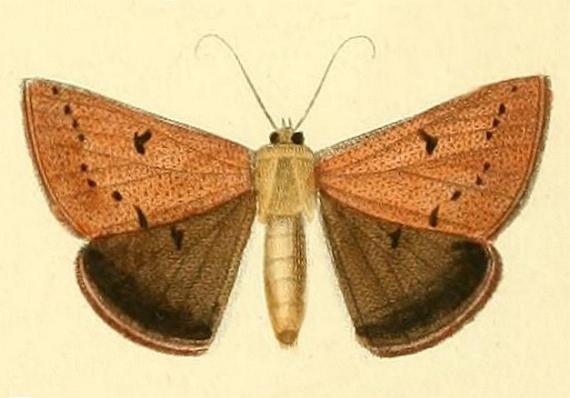
Androchela milvaria
engraved by Clergé.

Chlenias auctaria
engraved by Corbié,

Gastrina cristaria
engraved by Clergé.

Gastrinodes bitaeniaria
engraved by Clergé.

Melanodes anthracitaria
engraved by Clergé.

Mnesampela privata
engraved by Corbié,

Neritodes verrucata
engraved by Corbié,
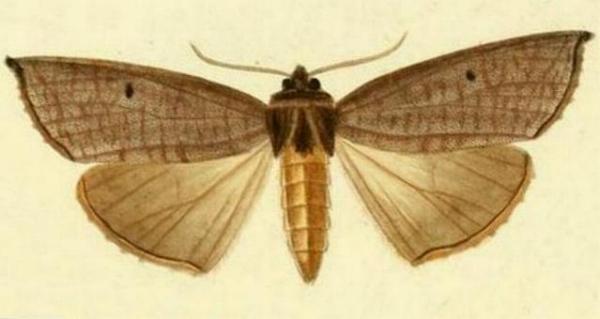
Paralaea beggaria
engraved by Corbié.

Smyriodes aplectaria
engraved by Corbié

Anisoneura aluco
engraved by Corbié

in progress

butterflies
Lepidoptera

artists

moths